
Last year, my friend Anna left the company she'd been with for years to go on maternity leave. Over the course of that year, AI progressed to the point where this IT contracting company fired most of its developers and broke its office lease. Their entire business structure changed, and they had to adapt. The programming language Anna specialized in had been largely overtaken by AI.
Yet, ironically, Anna was the one with the strongest ties to the company after all those years together — so contrary to the most likely outcome, she did return to her workplace, only to find it completely transformed, her role along with it.
This is just one tiny fragment of a much bigger picture, filled with thousands of stories like this — though most weren't as lucky as Anna.

According to the Tech Layoffs Tracker, 2026 layoffs have impacted 185,894 individuals as of today. That averages out to about 1,093 job losses per day.
Big tech companies are leading the trend: Amazon has eliminated at least 30,000 positions (roughly 10% of its corporate and tech workforce), Oracle is mid-restructuring with cuts expected to reach 30,000 — about 20% of its global workforce — and Meta has announced 8,000 layoffs with internal guidance suggesting nearly 20% headcount reduction across the full year.
Many of these workers were laid off overnight — an email informing them of their change in status, followed by immediate revocation of the tools connecting them to the company.
The funds saved by these layoffs have gone into fueling AI development.
Headlines suggest progressive AI advancement is the reason: the thesis being that rapid improvements in AI capabilities and adoption are making workers redundant. That, at least, is the narrative companies point to.
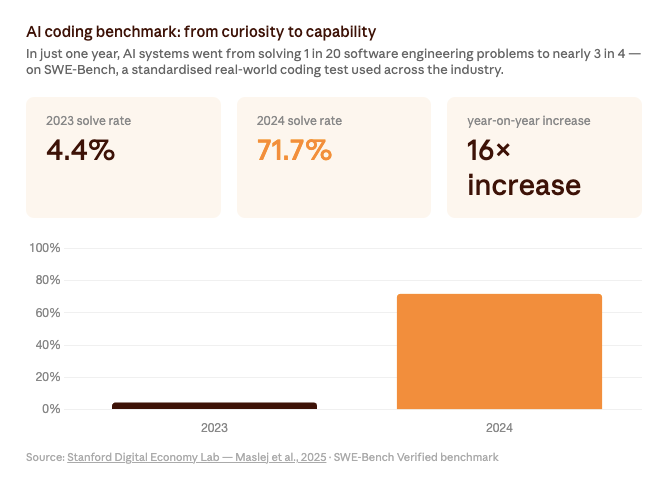
The more probable reality is that, although constant AI advancement is undeniable, its effect on work is not as large as the layoffs would suggest — at least not yet.
Studies show that in one of the fields most affected, software development, AI starts failing as task complexity increases — and even when it generates correct code, that code runs at least three times slower and uses far more memory than human-written code, and tends to be more complex and harder to maintain. Agents still very much need human oversight, expertise, and maintenance to function.
So What Is It, Then?
Given today's many existing setbacks, the term "AI washing" increasingly creeps into the discourse. The theory that workers are being laid off not because of AI, but because companies hired far more people than they actually needed — riding the wave of easy money during the pandemic-era hiring boom — seems plausible.
Marc Andreessen has pointed to this same pandemic overhiring as the primary driver, calling AI the "silver bullet excuse" companies now reach for.
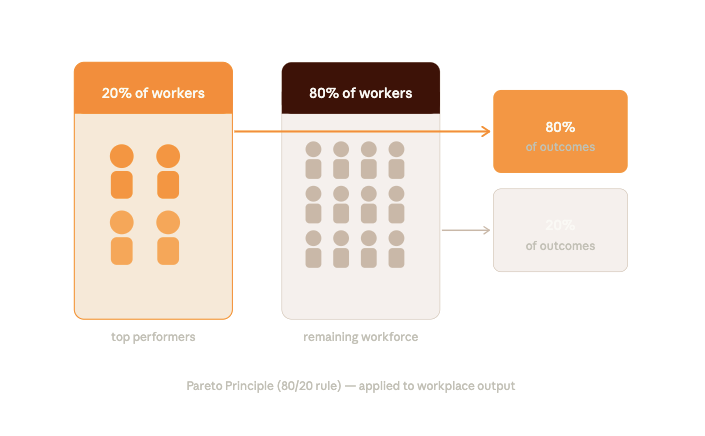
Paired with the Pareto Principle — the idea that roughly 80% of outcomes (results, output, value) come from about 20% of causes (effort, people, activities) — this would mean companies have always had more employees than they actually needed and have always known who their real 20% were — and now they have both the excuse and the tool to act on it. Now when that money can be poured into a substitute artificial workforce, these layoffs become justified under the banner of economic prosperity and proactive growth.
The question of cause and the question of treatment are inseparable — because how companies explain these cuts reveals what they actually think of the people they're cutting.
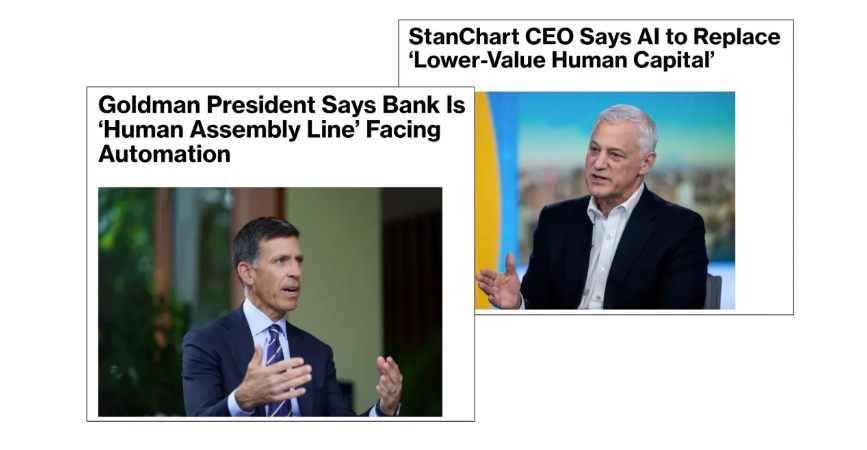
"Performance culture" is the phrase of the year. In that discourse, it becomes bluntly obvious what companies think of their workers — not only through the layoff numbers, not only through the mass 3am emails, but through the direct choice of words used to describe people: "human assembly line", "lower-value human capital."
It reveals something far more concerning than the development of AI itself — it shows where the US hiring market stands in relation to the humans inside it.
This is one of the points worth questioning alongside — or even before — asking what jobs AI will replace in the next 5 to 10 years. Because it isn't only a question of how many jobs AI will be capable of replacing, but, at this moment, even more importantly: how many it will be allowed to replace. And whether anyone will take responsibility for redirecting the displaced workforce toward something new.
A Different Approach Is Possible
Europe is already taking steps to protect jobs, requiring that all customer support bots disclose their nature and that customers can't be denied access to a real human instead of being stuck in an AI loop.
Other countries' examples — Japan, namely, where employees are traditionally hired for life and companies are expected to find new roles for displaced workers rather than let them go — show that technological advancement can coexist with a human-centered approach.
We don't have to inflict generational trauma as a rite of passage into a new technological era.
At this pace, companies might ultimately fall into their own trap: realizing, once the technology settles and becomes equally available to everyone, that all those humans made redundant were their real differentiator all along.